
A Guide to Sidewalk Gratings in Canada
Introduction
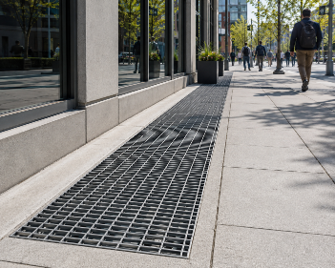
Sidewalk grating may look like a simple part of a building or streetscape, but it has an important job to do. It must provide a comfortable walking surface while allowing air, water or debris to pass through. Depending on the location, it may also need to support maintenance equipment, service vehicles or occasional traffic.
In Canada, the job becomes even more demanding. Grating installed outdoors has to perform through rain, snow, ice, freeze-thaw cycles and regular exposure to moisture. In public spaces, pedestrian comfort and accessibility must also be considered.
Choosing the right product means looking beyond the dimensions of the opening. Material, construction, bar spacing, load requirements, slip resistance and surrounding conditions all affect how well the finished installation performs.
Table des matières

Why Sidewalk Grating Requires Careful Planning
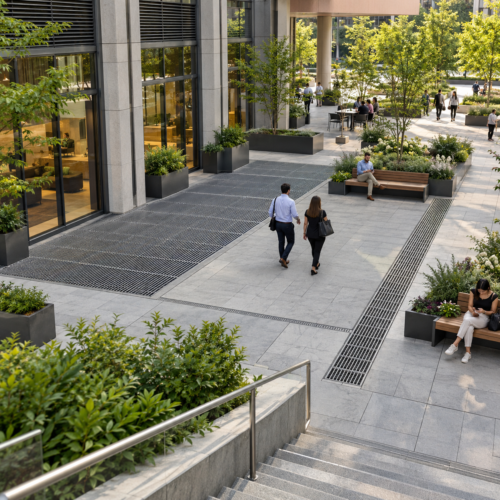
Sidewalk grating is commonly used where a solid walking surface would interfere with drainage, ventilation, access or another function below the walking area.
You may find it over ventilation areas beside buildings, around mechanical spaces, above trenches and utility areas, or incorporated into public plazas and other pedestrian environments.
The challenge is that the opening still needs to function as part of the walking surface.
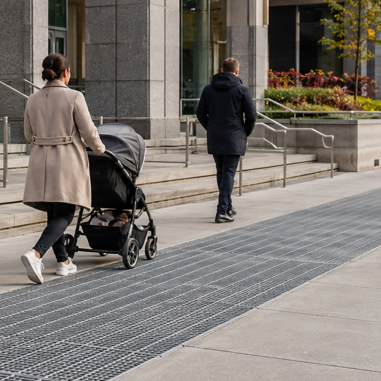
Pedestrians may cross it wearing everything from work boots to dress shoes. People may use wheelchairs, walkers, canes, strollers or other mobility devices. In commercial or institutional settings, hundreds or thousands of people may travel across the same area each day.
Canadian accessibility requirements also address accessible outdoor paths of travel, while national accessibility guidance includes considerations for openings in walking surfaces and the orientation of elongated openings.
That means sidewalk grating should be selected as part of the overall design of the pedestrian area rather than treated simply as a cover for an opening.
Who Will Be Using the Surface?
A good sidewalk grating guide starts with one basic question.
Who will be walking across it?
Grating used on an industrial maintenance walkway can have very different requirements from grating installed outside a hospital, transit station, office tower or municipal building.
For public pedestrian applications, important factors can include:
- Opening size and orientation
- Stability under foot
- Heel and walking comfort
- Mobility-device use
- Slip resistance
- Changes in elevation
- Transitions between the grating and surrounding pavement
Smaller openings can help create a more comfortable pedestrian surface and reduce the possibility of heels or walking aids becoming caught in the grating.
Borden Sidewalk Grating is specifically designed with smaller openings for pedestrian comfort while maintaining structural strength. Different bearing bar and cross-bar configurations are available to accommodate project requirements.
Accessibility requirements can vary according to the type and location of a project. Designers and contractors should always review the applicable building code, municipal requirements, accessibility standards and project specifications before selecting a grating system.
What Does Sidewalk Grating Need to Do?

Pedestrian traffic is only one part of the specification.
The next step is understanding why the opening exists.
In some applications, the main purpose is drainage. In others, the grating allows ventilation into mechanical equipment or spaces below grade. It may provide access to utilities or create a removable walking surface over a trench.
The amount of open area within the grating therefore matters.
A project may need to balance several requirements at once:
Pedestrian comfort
The openings should be appropriate for the intended walking environment.
Drainage
Rainwater and melting snow must be able to move through the surface efficiently.
Airflow
Grating positioned above ventilation openings may need a specific amount of free area.
Structural performance
The panel must support the required loads over its span.
Access
Some panels may need to be removable for inspection or maintenance.
These factors are interconnected. Changing bearing-bar spacing, cross-bar spacing or bar dimensions can affect both the amount of open area and the structural performance of the panel.
For that reason, grating selection should ideally happen while the opening, supports and surrounding construction are being designed.
Which Grating Construction and Material Should You Choose?
For sidewalk applications, it helps to separate the use of the grating from the way it is constructed.
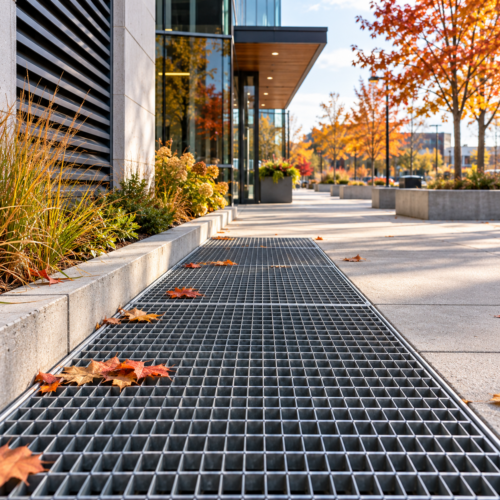
Borden’s sidewalk grating is part of its pressure locked grating family. Pressure locked grating is made by pressing precisely slotted bars together to create a permanent mechanical lock. This construction allows for smaller, uniform openings that work well in pedestrian areas while still providing drainage, airflow and structural strength.
Borden offers several sidewalk grating configurations, including Types C, BB, LL and DD, with different bearing-bar and cross-bar spacings to suit the application.
Material selection is also important. Borden pressure locked grating is available in carbon steel, galvanized steel, aluminum and stainless steel.
- Carbon steel offers strength and durability.
- Galvanized steel adds corrosion protection for outdoor environments.
- Aluminum is lightweight and corrosion resistant.
- Stainless steel may be appropriate where corrosion resistance, appearance or cleanliness is especially important.
The final choice should consider span, load requirements, pedestrian use, drainage, slip resistance and environmental exposure.
Learn more about Borden Sidewalk Gratings and Pressure Locked Gratings.
How Do You Improve Slip Resistance and Winter Performance?
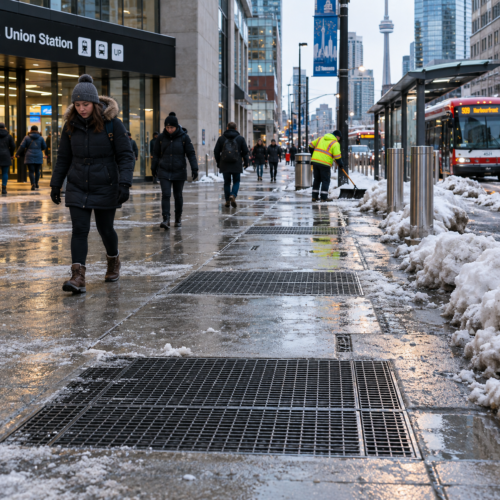
Any outdoor walking surface in Canada has to deal with changing weather.
A sidewalk that is dry in September may be wet with rain in October, covered in melting snow in January and exposed to freeze-thaw conditions in March.
Grating has an advantage because its open construction can allow water and melting snow to pass through rather than remain entirely on the surface. But surface traction still deserves attention.
Borden sidewalk grating can be supplied with enhanced slip-resistant options, including the premium ALGRIP® surface or a mechanically punched serrated finish.
The appropriate surface depends on the location and use.
Areas where slip resistance may deserve particular consideration include building entrances, transit infrastructure, loading areas, exterior stairs and walkways, industrial facilities and locations exposed directly to precipitation.
Maintenance is still important. Snow, ice, dirt or other material can accumulate on or around almost any exterior walking surface if the area is not properly maintained.
What Loads Does Sidewalk Grating Need to Support?

One of the biggest mistakes in specifying pedestrian grating is assuming that pedestrian traffic will always be the only load.
A sidewalk may occasionally need to support:
- Maintenance carts
- Cleaning equipment
- Snow-removal equipment
- Landscaping equipment
- Emergency or service equipment
- Light vehicles in mixed-use areas
Borden sidewalk grating is designed to provide pedestrian comfort while also offering the structural strength needed for applications that may experience occasional vehicular loading.
That does not mean every sidewalk grating configuration is suitable for every vehicle.
Bearing-bar depth and thickness, spacing, clear span, support conditions and load type all affect capacity. Point loads can also behave differently from uniformly distributed loads.
The design team should establish expected loading conditions before selecting a panel.
Borden publishes load information for its sidewalk grating configurations, and its sidewalk products are designed to the requirements of ANSI/NAAMM MBG 534-24. Local municipal codes and project-specific requirements should also be reviewed.
What Should You Consider for Installation, Drainage and Maintenance?
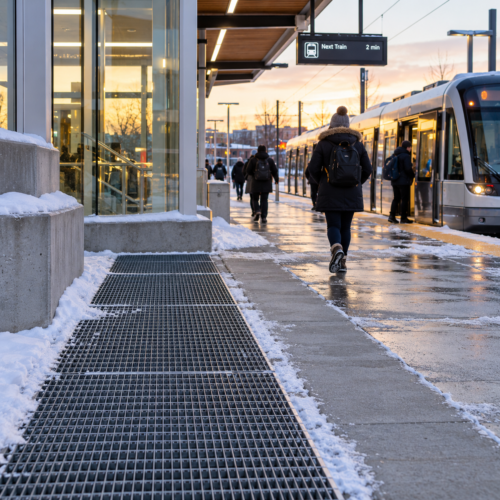
Even properly selected grating depends on proper support.
The supporting frame and surrounding construction must be capable of transferring loads safely. Panels should have sufficient bearing at their supports and should fit the opening without creating unsafe gaps or changes in level.
Designers should also consider how the grating will be secured.
A permanently installed pedestrian panel has different requirements from a panel that must occasionally be removed to access a utility space.
Where panels are removable, maintenance staff should be able to remove and replace them without damaging the panel, supporting frame or surrounding surface.
Transitions matter as well. A strong grating panel can still create a pedestrian concern if the surrounding concrete settles or if the frame ends up above or below the adjacent sidewalk.
The entire assembly needs to be treated as part of the walking surface.
Think About Drainage Beyond the Grating
Open grating can help water pass through a walking surface, but it cannot solve a drainage problem by itself.
Water still needs somewhere to go.
The space below the panel should be designed so water can drain rather than collect underneath. Leaves, litter, sediment and winter debris may also need to be removed periodically.
In urban environments, designers should consider how the opening will be inspected and cleaned after installation.
This is particularly important where the grating forms part of a stormwater, ventilation or utility system.
The goal is not simply to get water through the grating. It is to keep the entire system functioning over the long term.
Plan for Canadian Conditions
A useful sidewalk grating guide for Canada has to account for winter.
Canada’s infrastructure experiences repeated changes between freezing and thawing temperatures. Snow and ice management can introduce moisture, salt and other de-icing materials to pedestrian surfaces.
For outdoor grating, specification should therefore consider:
- Corrosion exposure
- Drainage
- Slip resistance
- Snow and ice removal
- Seasonal debris
- Inspection and cleaning access
Material and finish should be chosen for the actual location. A covered entrance may experience very different exposure from a downtown sidewalk, transit platform or industrial yard.
Good specification starts with understanding those conditions rather than selecting a standard panel and hoping it fits the application.
FAQ rapide
What is sidewalk grating used for?
Sidewalk grating provides a walkable surface over areas that still require drainage, airflow or access. Common applications include building ventilation openings, trenches, utility spaces, plazas, transit facilities and municipal pedestrian areas.
What makes sidewalk grating different from ordinary industrial grating?
Sidewalk grating typically uses spacing and configurations intended to improve pedestrian comfort and reduce larger openings in the walking surface. The design may also need to account for accessibility requirements and occasional vehicle loads.
Can sidewalk grating support vehicles?
Certain sidewalk grating configurations can be designed for occasional vehicular loading, but capacity depends on the bearing bars, span, support conditions and expected load. Vehicle requirements should always be identified during specification rather than assumed.
Which material is best for outdoor sidewalk grating?
Carbon steel, aluminum and stainless steel can all be appropriate depending on the application. The right choice depends on structural requirements, corrosion exposure, weight, maintenance expectations and the surrounding environment.
Is slip-resistant sidewalk grating available?
Yes. Enhanced traction can be provided using surface treatments or serrated configurations. Borden offers both its ALGRIP® surface and mechanically punched serrated options for sidewalk grating.
Talk to Borden About Your Sidewalk Grating Project
Since 1955, Borden Metal Products (Canada) Ltd. has manufactured bar-on-edge gratings at its facility in Beeton, Ontario. Over that time, the Borden name has become associated with dependable grating products used in projects across Canada.
Borden manufactures a complete line of riveted, pressure locked, squeeze locked and resistance welded gratings in carbon steel, aluminum and stainless steel alloys.
Whether you are designing a municipal sidewalk, commercial development, transit facility, industrial site or another pedestrian area, the right grating starts with understanding the conditions it needs to handle.
Use this sidewalk grating guide as a starting point, then work with an experienced manufacturer to confirm spacing, material, loading, slip resistance and other project requirements.
Learn more about Borden Sidewalk Gratings or contact us to book a consultation.