
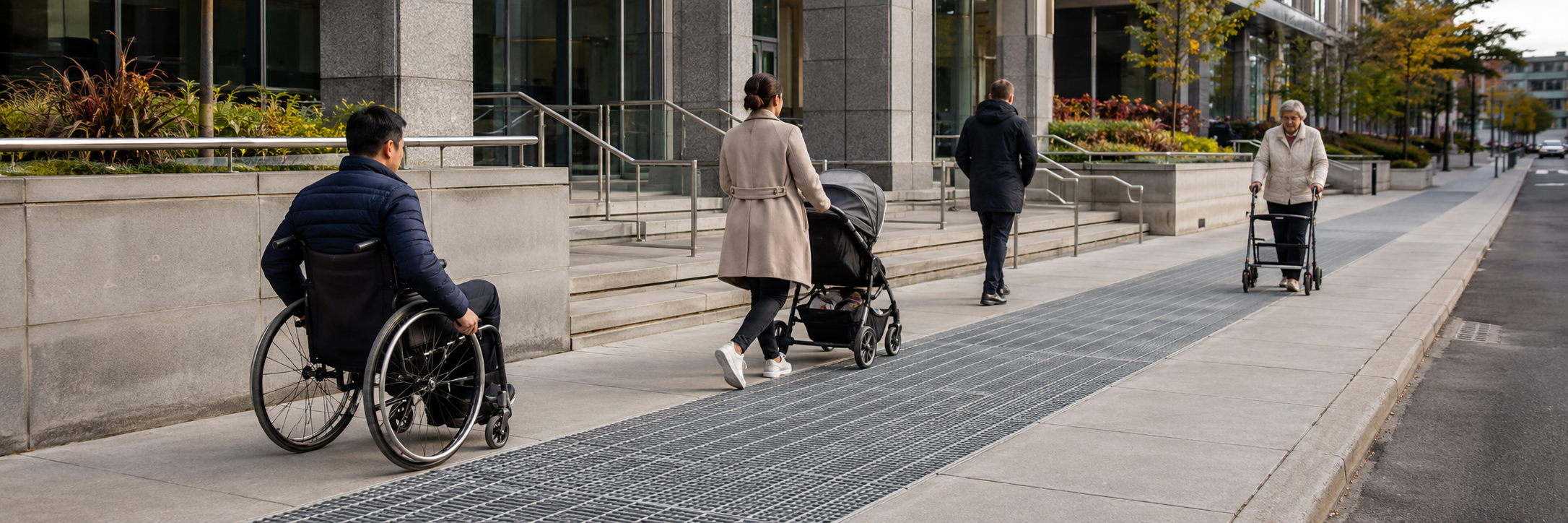
Sidewalk and pedestrian grating often has to do two jobs at once. It needs to provide drainage, ventilation or access below the surface while remaining comfortable and safe for the people travelling across it.
That makes pedestrian grating accessibility an important consideration when specifying grating for sidewalks, plazas, transit facilities, commercial properties and institutional spaces.
The challenge is not simply choosing a strong panel. Opening size, opening orientation, surface stability and transitions to surrounding pavement can all affect how the grating performs for pedestrians.
Consider Opening Size and Orientation
Large openings can create difficulties for wheels, canes and other mobility devices, while smaller openings may also provide a more comfortable surface for general pedestrian traffic.
Orientation matters too. Accessibility Standards Canada’s CAN-ASC-2.1 outdoor-spaces standard specifies that surface openings should not allow a 13 mm sphere to pass through and that elongated openings should run perpendicular or diagonal to the direction of travel.
Ontario’s Design of Public Spaces requirements use a 20 mm maximum opening criterion for applicable exterior paths of travel, with elongated openings oriented approximately perpendicular to the direction of travel. Project-specific requirements should always be confirmed.
Borden sidewalk grating is available in configurations with smaller openings intended to improve pedestrian comfort while maintaining structural performance. Bearing-bar and cross-bar spacing can also be selected to accommodate drainage and free-air requirements.
Think Beyond Wheelchairs
Good pedestrian grating design considers both accessibility and the needs of a wide range of pedestrians.
That can include people using:
- Wheelchairs or scooters
- Walkers and canes
- Strollers
- Narrow-heeled footwear
A surface that supports the required load may still be uncomfortable or difficult to cross if its openings, orientation or surrounding installation are poorly suited to pedestrian use.
Keep Transitions Smooth and Stable
The grating is only one part of the walking surface. The frame, surrounding concrete and adjoining pavement matter too.
Panels should sit securely within their supports without creating unnecessary gaps or abrupt changes in elevation. Designers should also address drainage, slip resistance and the long-term stability of surrounding surfaces.
Smooth transitions can make the overall installation easier and more comfortable to navigate for people using mobility devices as well as other pedestrians.
Check the Requirements for the Project
There is no single pedestrian grating accessibility requirement that applies to every project.
Ontario’s Design of Public Spaces Standards apply to certain newly constructed or redeveloped public spaces, including applicable exterior paths of travel. The Ontario Building Code also contains barrier-free design requirements for new construction and certain extensive renovations.
Municipal accessibility standards and individual project specifications may add further requirements or call for more restrictive dimensions. Confirm all applicable criteria before finalizing the grating configuration.
Choosing Pedestrian Grating
The right solution balances accessibility, structural performance, drainage and the conditions of the site. Considering these factors early can help create a walking surface that works for more people and performs reliably over time.
Borden has manufactured bar-on-edge grating in Beeton, Ontario, since 1955. Explore our sidewalk grating options, read our complete sidewalk grating guide [LINK COMING SOON], or contact Borden to discuss pedestrian grating accessibility requirements for your project.
FAQ rapide
Pedestrian grating typically uses smaller openings and configurations designed to provide a more comfortable walking surface while maintaining the required structural strength, drainage or airflow.
Yes. The orientation of elongated openings can affect wheels, canes and other mobility devices. Applicable accessibility standards and project specifications should be reviewed when planning the installation.
Yes. Bearing-bar and cross-bar spacing can be selected to balance pedestrian requirements with the free area needed for drainage or ventilation.