
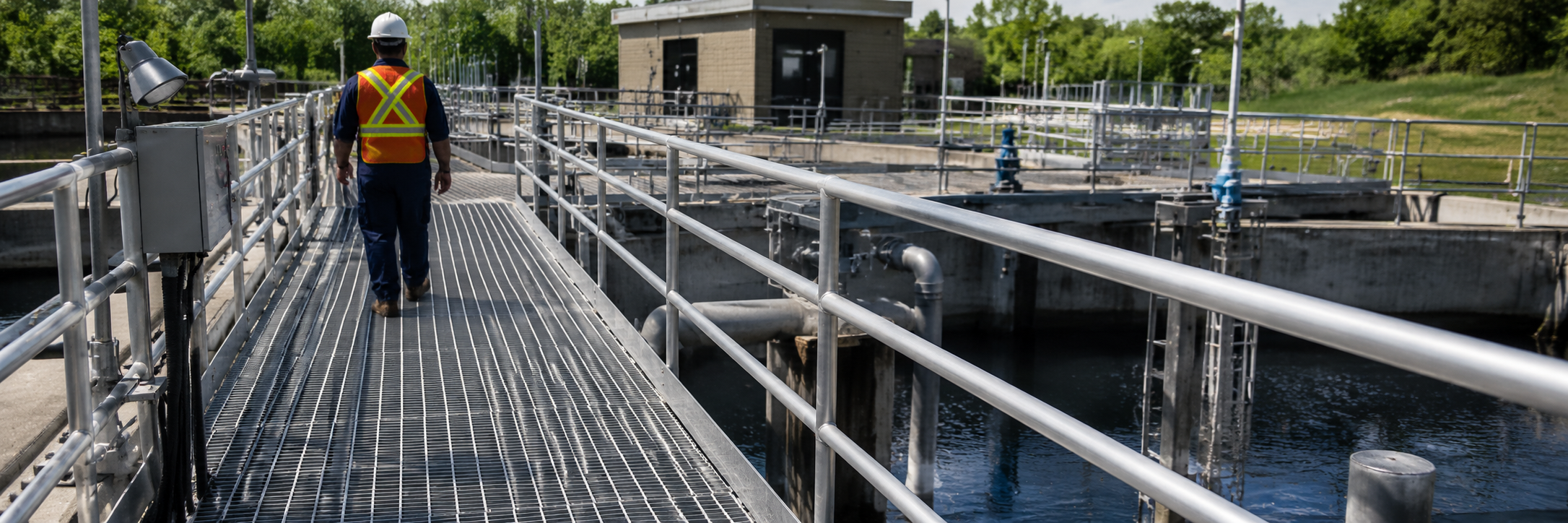
Pressure locked steel bar grating should be specified by reviewing expected loads, clear spans, bar size, spacing, support conditions, material finish and site exposure.
Specifying metal grating is not just about choosing a panel size. The grating must fit the structure, support the expected loads and perform safely in the project environment.
Pressure locked steel bar grating is often used for industrial walkways, platforms, stair landings, municipal facilities and building service areas. It provides a strong open-grid surface while allowing air, water, light and debris to pass through. This article covers the key details to review before it is added to drawings or ordered for a project.
Start With Loads and Clear Spans
The first step is to understand what the grating must support. Pedestrian traffic, maintenance carts, tools, equipment parts and concentrated wheel loads can all affect the specification.
Clear span is equally important. This is the unsupported distance between structural supports. A longer span may require deeper or heavier bearing bars. The bearing bars must also run in the correct direction so the load is transferred properly to the structure below.
Choose Bar Size and Spacing
Pressure locked steel bar grating can be made with different bearing bar depths, thicknesses and spacing patterns. These choices affect strength, open area, drainage, walking comfort and appearance.
Closer spacing may be preferred for public or high-traffic areas. More open spacing may work well in industrial areas where drainage, airflow or visibility below the surface matters.
Specifiers should also consider:
- Cross-bar spacing
- Panel size and weight
- Banding requirements
- Cut-outs for pipes, columns or drains
- Fastener type and placement
Account for Site Conditions
The project location has a major effect on material and finish. Indoor dry spaces may have different requirements than rooftops, exterior platforms or water treatment facilities.
In Southern Ontario, pressure locked steel bar grating may be exposed to moisture, snow, road salt, freeze-thaw cycles and industrial contaminants. Galvanized steel is often considered for exterior or damp environments, while other materials may suit more corrosive settings.
Key Considerations for Drawings and Specifications
Clear documentation helps avoid delays and field adjustments. Drawings should identify panel layout, bearing bar direction, support locations, cut-outs, fastening requirements and any special finish or slip-resistance needs.
If the grating must meet building, safety or accessibility requirements, those expectations should be reviewed early in the design process.
Specify for the Real Application
The right pressure locked steel bar grating specification considers load, span, spacing, material, finish and installation details together. A well-planned specification supports safer access and a longer service life.
Borden Metal Products has manufactured bar-on-edge gratings in Beeton, Ontario, since 1955.
Discuss Your Grating Requirements
Review Borden’s pressure locked grating options to learn more about available configurations.
Read the complete guide to pressure locked grating for a broader overview of applications and selection.
Contact us to discuss your project requirements with the Borden team.
FAQ rapide
Key details include load requirements, clear span, bearing bar direction, bar size, spacing, material finish, panel layout and fastening method.
Bearing bars carry the load between supports. If they run the wrong way, the grating may not perform as intended.
It is often considered for outdoor or damp locations because the zinc coating helps protect the steel from corrosion.