
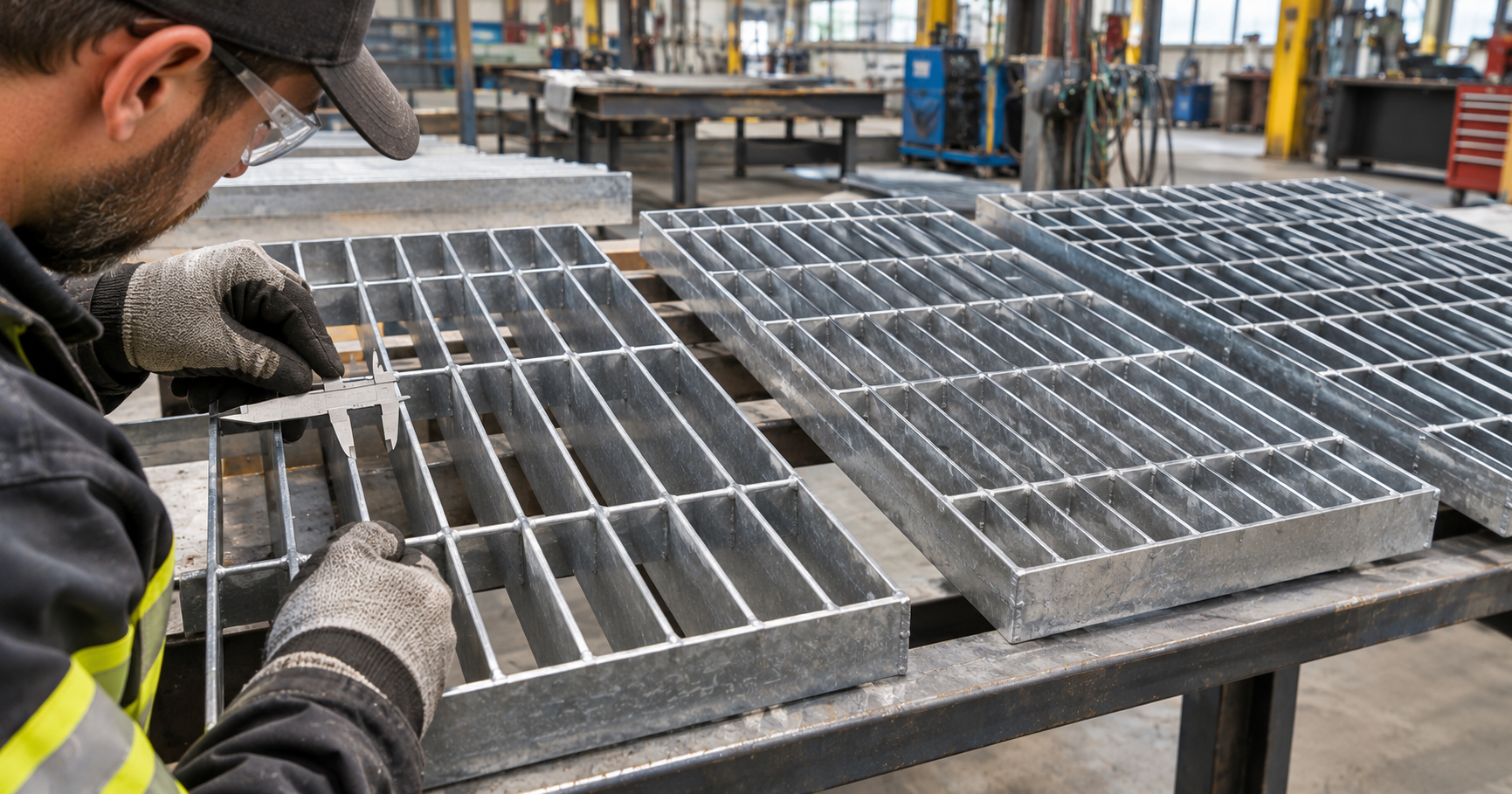
Understanding bar grating specifications is essential when selecting metal grating for industrial flooring, walkways, platforms, and other applications. Codes such as 19-W-4, 19-W-2, and 15-W-4 identify how the grating is constructed and how its bars are spaced. These designations help engineers, contractors, and facility managers compare grating configurations and choose suitable products for their projects.
What Do Bar Grating Specification Codes Mean?
Most welded bar grating specifications follow a straightforward numbering system. Each part of the code identifies a particular characteristic.
Using 19-W-4 as an example:
- 19: Bearing bars are spaced 19/16 inches (1-3/16 inches) apart, measured centre to centre.
- W: Indicates welded grating construction.
- 4: Crossbars are spaced 4 inches apart, measured centre to centre.
These measurements describe the grating’s layout, but not its overall strength, bearing-bar dimensions or material.
How Do 19-W-4, 19-W-2 and 15-W-4 Compare?
Although these codes look similar, their differences can influence grating selection.
| Grating Code | Bearing-Bar Spacing | Crossbar Spacing |
| 19-W-4 | 1-3/16 inches | 4 inches |
| 19-W-2 | 1-3/16 inches | 2 inches |
| 15-W-4 | 15/16 inches | 4 inches |
| 15-W-2 | 15/16 inches | 2 inches |
| 11-W-4 | 11/16 inches | 4 inches |
The closer spacing of 15-W-4 and 11-W-4 creates smaller openings between bearing bars. Meanwhile, 19-W-2 provides more closely spaced crossbars than 19-W-4.
Borden manufactures these configurations under its own product designations, including Type W/B (19-W-4), Type W/F (19-W-2), and Type W/DA (15-W-4).
What Else Should You Look for in Bar Grating Specifications?
Spacing is only one part of selecting the correct grating. Other important specifications include:
- Bearing-bar depth and thickness: Affect load capacity and deflection.
- Material: Carbon steel, aluminum, and stainless steel offer different properties.
- Surface finish: Smooth or serrated surfaces may suit different operating conditions.
- Span and loading: Determine whether the grating can safely support expected loads.
Reviewing these details alongside the spacing code provides a more complete understanding of the product.
Why Is Correct Specification Important?
Two gratings with identical spacing codes can perform differently depending on their bearing-bar dimensions, material, and support conditions.
For Ontario industrial and commercial projects, designers should also consider applicable building requirements, workplace safety, and accessibility needs.
Choosing the Right Bar Grating
Understanding bar grating specifications makes it easier to compare products and communicate project requirements.
Explore Borden’s welded grating products and corresponding load tables, or contact Borden for assistance selecting a suitable configuration.
Frequently Asked Questions
What Does 19-W-4 Mean in Metal Grating?
19-W-4 identifies welded bar grating with bearing bars spaced 1-3/16 inches apart and crossbars spaced 4 inches apart, measured centre to centre.
Is 15-W-4 Stronger Than 19-W-4?
With otherwise identical bearing bars and materials, the closer bearing-bar spacing of 15-W-4 can provide greater load capacity per unit width. Actual performance depends on the complete grating specification.
Does a Grating Code Tell You Its Load Capacity?
No. The spacing code identifies the grating configuration. Load capacity also depends on bearing-bar dimensions, material, span and support conditions.