
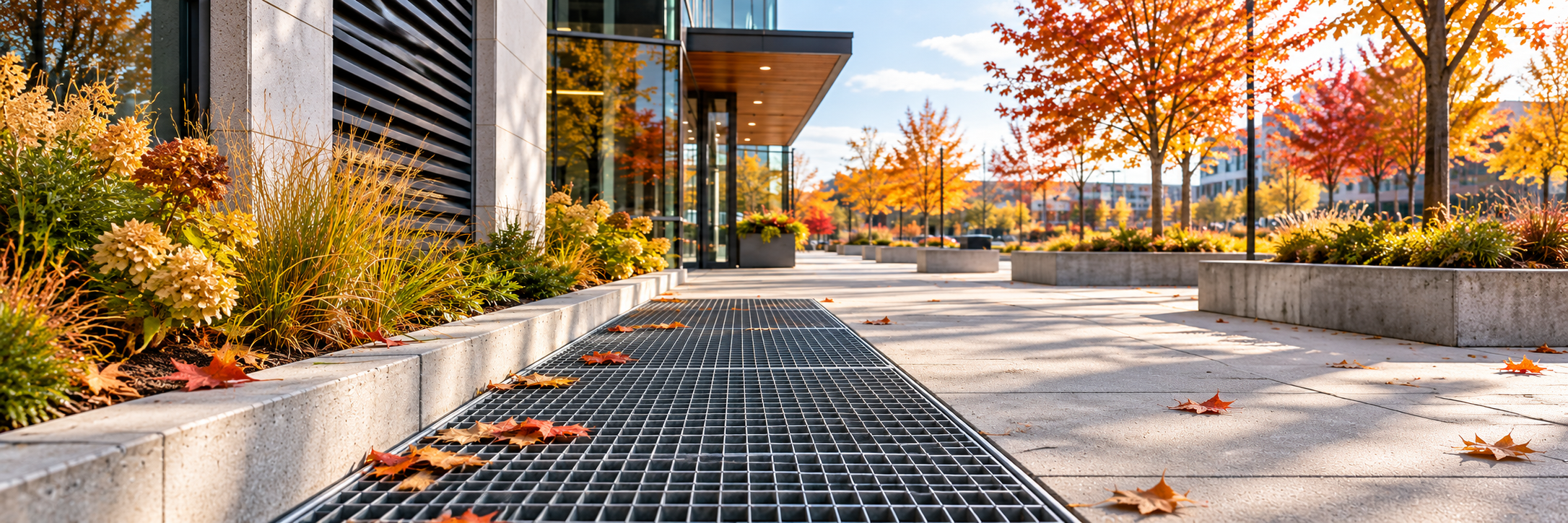
Choosing sidewalk grating is not just a matter of picking a panel that fits the opening.
The grating has to work as part of the pedestrian surface while also meeting structural, drainage and environmental requirements. That means looking at how the grating is constructed, how the bars are spaced, what loads it needs to support and which material is best suited to the site.
For Borden products, there is also an important distinction to understand from the start.
“Sidewalk grating” describes the application and performance requirements. “Pressure locked” describes how the grating is constructed. Borden’s sidewalk grating products are part of its pressure locked grating family. The right sidewalk grating construction therefore starts with choosing the appropriate pressure locked configuration and then matching the material, spacing and load capacity to the project
Why Is Pressure Locked Grating Used for Sidewalks?
Pressure locked grating is made by hydraulically pressing two precisely slotted bars together to form a permanent mechanical lock.
This creates a clean, uniform grid while giving designers flexibility in bar size and spacing. That flexibility is especially useful for pedestrian applications because the openings can be kept relatively small without giving up the drainage, ventilation and structural benefits of open metal grating.
For a sidewalk, that matters.
A grating may need to accommodate pedestrians wearing different types of footwear, people using mobility aids, maintenance equipment and, in some locations, occasional vehicle traffic. At the same time, the opening may be there to provide ventilation, drainage or access to equipment below.
A well-specified sidewalk grating construction has to balance all of those demands rather than focusing on any one factor in isolation.
What Sidewalk Grating Configurations Does Borden Offer?
Borden lists four main sidewalk grating families:
- Type C — 11-P-4 and 11-P-2
- Type BB — 9.5-P-4 and 9.5-P-2
- Type LL — 8-P-4 and 8-P-2
- Type DD — 6.5-P-4 and 6.5-P-2
These same product families also appear within Borden’s pressure locked grating information, with dedicated sidewalk load tables for pedestrian applications.
The different configurations give designers options when balancing pedestrian comfort, drainage, airflow and structural capacity.
That is important because there is no single sidewalk grating configuration that is automatically right for every project.
What Do the Product Designations Mean?
A designation such as 11-P-4 identifies a pressure locked grating configuration with a particular bearing-bar and cross-bar spacing.
Those spacings affect more than appearance.
- The size of the openings
- Pedestrian comfort
- Drainage
- Free-air area
- Structural performance
- The type of loading the grating can accommodate
Borden offers several configurations so designers can choose a spacing that makes sense for the specific project rather than simply selecting the smallest opening available. That makes the load tables and project requirements an important part of selecting the final sidewalk grating construction.
Which Material Should You Choose?
Once the grating configuration has been established, material becomes the next major decision.
Borden pressure locked grating is available in carbon steel, galvanized steel, aluminum and stainless steel.
Each material has different advantages.
Carbon Steel
Carbon steel is commonly selected where strength and durability are priorities.
For exterior sidewalk applications, corrosion protection also needs to be considered. Bare carbon steel may not be appropriate for every outdoor environment, particularly where the grating will be exposed to frequent moisture or de-icing materials.
Galvanized Steel
Galvanized steel adds a protective zinc coating to help resist corrosion.
That makes it particularly useful for exterior applications where the grating will be exposed to rain, snow, moisture and road salt or other de-icing materials.
For many outdoor pedestrian applications in Ontario, galvanized steel can provide a practical balance of strength and corrosion protection.
Aluminum
Aluminum offers good corrosion resistance while weighing less than steel.
Lower weight can be useful where grating panels need to be removed periodically for access, maintenance or inspection. It may also be helpful where reducing the overall weight of the assembly is an important design consideration.
Stainless Steel
Stainless steel may be appropriate where corrosion resistance, cleanliness or appearance is particularly important.
It can be considered for locations exposed to moisture, more aggressive environments or where long-term appearance is an important part of the project.
Material selection still needs to be considered together with bearing-bar size, span, loading and support conditions.
What Else Should Be Considered?
Choosing sidewalk grating construction is not simply a choice between materials.
The final specification should consider the complete application, including:
- Pedestrian and accessibility requirements
- Bearing-bar and cross-bar spacing
- Clear span
- Pedestrian loads
- Occasional vehicle or equipment loads
- Drainage requirements
- Free-air requirements
- Corrosion exposure
- Slip resistance
- Support and fastening conditions
Borden sidewalk grating is designed to combine pedestrian comfort with structural strength, and some configurations can accommodate occasional vehicular loads. Borden also offers ALGRIP® and mechanically punched serrated surfaces where additional traction is required.
This is why construction, material and surface treatment should be considered together rather than specified as separate decisions.
A galvanized pressure locked panel with a particular spacing may be appropriate for one municipal walkway, while an aluminum or stainless steel configuration may make more sense for another project with different corrosion, weight or appearance requirements.
Why Do Ontario Conditions Matter?
Outdoor sidewalk grating in Ontario has to deal with conditions that can change considerably over the course of the year.
Freeze-thaw cycles can introduce repeated moisture exposure. Snow and ice management may bring salt and other de-icing materials into contact with the grating. Melting snow also increases the importance of drainage.
For exterior installations, the designer should therefore consider:
- How often the grating will be wet
- Whether de-icing salts will be used nearby
- How quickly water can drain away
- Whether snow and ice could accumulate
- How the grating will be inspected and maintained
- Whether additional slip resistance is appropriate
These conditions can influence both material selection and surface treatment.
FAQs About Sidewalk Grating Construction
Not exactly.
Sidewalk grating describes the application, while pressure locked describes the construction method. Borden’s sidewalk grating products use pressure locked construction in configurations designed for pedestrian applications
There is no single best material for every project.
Carbon steel, galvanized steel, aluminum and stainless steel can all be appropriate depending on the required strength, corrosion exposure, weight, appearance and maintenance conditions. For outdoor Ontario applications, moisture, snow and de-icing materials should be considered when selecting the material.
Some Borden sidewalk grating configurations can accommodate occasional vehicular loading, but this depends on the bearing bars, spacing, clear span and expected load. Load requirements should be established before the grating configuration is selected.
Choose Sidewalk Grating as a Complete System
The best sidewalk grating construction is not determined by one feature alone.
Material, spacing, span, load requirements, drainage, corrosion exposure and slip resistance all need to work together.
For Ontario facilities, freeze-thaw cycles, snow and de-icing materials should also be considered when specifying exterior grating. A product that performs well structurally still needs to suit the environment in which it will be installed.
Borden has manufactured bar-on-edge grating in Beeton, Ontario, for more than 70 years, with products available in carbon steel, aluminum and stainless steel.
Explore Borden’s sidewalk grating options, read our complete sidewalk grating guide, or contact Borden to discuss the right sidewalk grating construction for your project.