
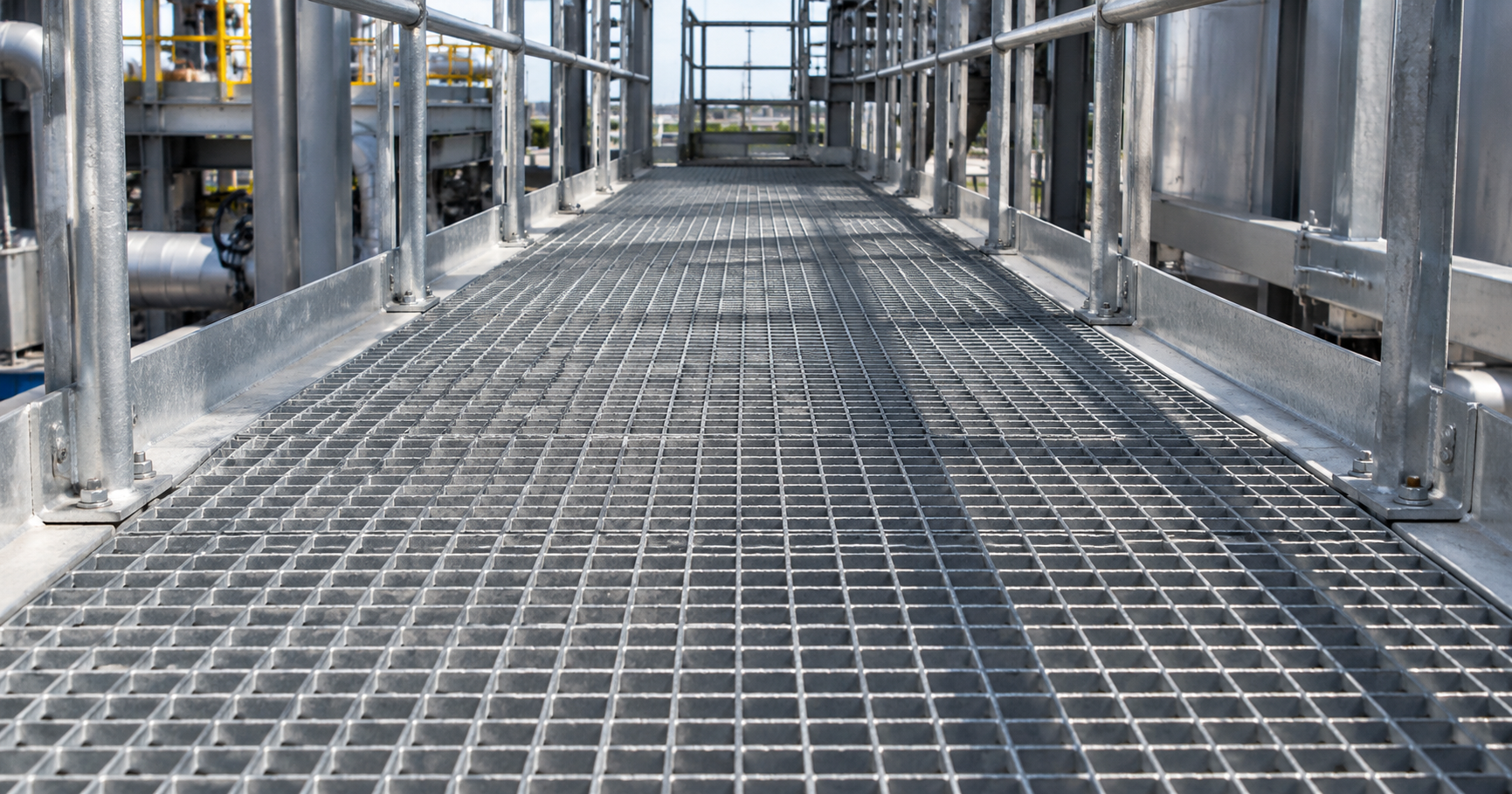
19-W-4 bar grating is a welded steel grating pattern with bearing bars spaced 1-3/16 inches (approximately 30 mm) centre to centre and crossbars spaced 4 inches (approximately 102 mm) centre to centre.
It is used for industrial walkways, platforms and other open-grid flooring where drainage, ventilation and structural performance matter. For buyers researching 19-W-4 grating in Canada, the spacing code is the starting point—not the complete specification.
What Does 19-W-4 Tell You?
The designation breaks down into three parts:
- 19: Bearing-bar spacing of 19/16 inches, measured centre to centre.
- W: Resistance-welded construction, with crossbars joined to the bearing bars.
- 4: Crossbar spacing of 4 inches, measured centre to centre.
Borden identifies this configuration as Type W/B. The code describes the grid pattern but does not identify bearing-bar depth, thickness, finish or allowable load.
Where Is This Grating Commonly Used?
Its relatively open pattern makes 19-W-4 useful in industrial settings where water, dirt or debris needs to pass through the walking surface. Typical applications may include equipment platforms, maintenance walkways, service areas and industrial flooring.
The right application depends on how the space is used. A pedestrian maintenance platform has different loading and opening requirements from a public walkway, equipment crossing or vehicle-access area. Do not assume that a familiar grating pattern is suitable for every location.
What Must a Canadian Project Specification Include?
When requesting 19-W-4 grating in Canada, give the supplier enough information to select and fabricate a suitable panel:
- Design load and clear span, including whether loads are concentrated or uniform.
- Bearing-bar depth, thickness and direction of span.
- Panel dimensions, support details and fastening requirements.
- Surface treatment, such as smooth or serrated bars, and the specified protective finish.
- Environmental conditions, including moisture, corrosion and winter exposure.
Consult Borden’s welded-grating load tables for the selected bearing-bar size and span. Engineers should also confirm applicable building, workplace safety and accessibility requirements for the project.
How Does 19-W-4 Compare With 19-W-2?
Both patterns use the same nominal bearing-bar spacing. The difference is crossbar spacing: 19-W-2 has crossbars every 2 inches rather than every 4 inches. This changes the grid geometry, but does not by itself establish that either product meets a given load requirement. Compare complete specifications and load tables.
Choosing the Right Grating
A good specification begins with the application, not just the code. Confirm span, loading, surface conditions and installation details before selecting a panel.
Review Borden’s welded grating products and load tables, or contact Borden to discuss your project requirements.
Quick FAQ
It can be, when the material, protective finish, loading and exposure conditions are appropriate. Outdoor applications may require corrosion protection and consideration of snow, ice and drainage.
No. It describes welded construction and bar spacing. Load capacity depends on bearing-bar dimensions, span, material and support conditions.
Borden lists 19-W-4 welded grating as Type W/B on its welded grating product page.